Add it to your cut list, or continue with the pieces and files already included.
CUT TO YOUR DIMENSIONS
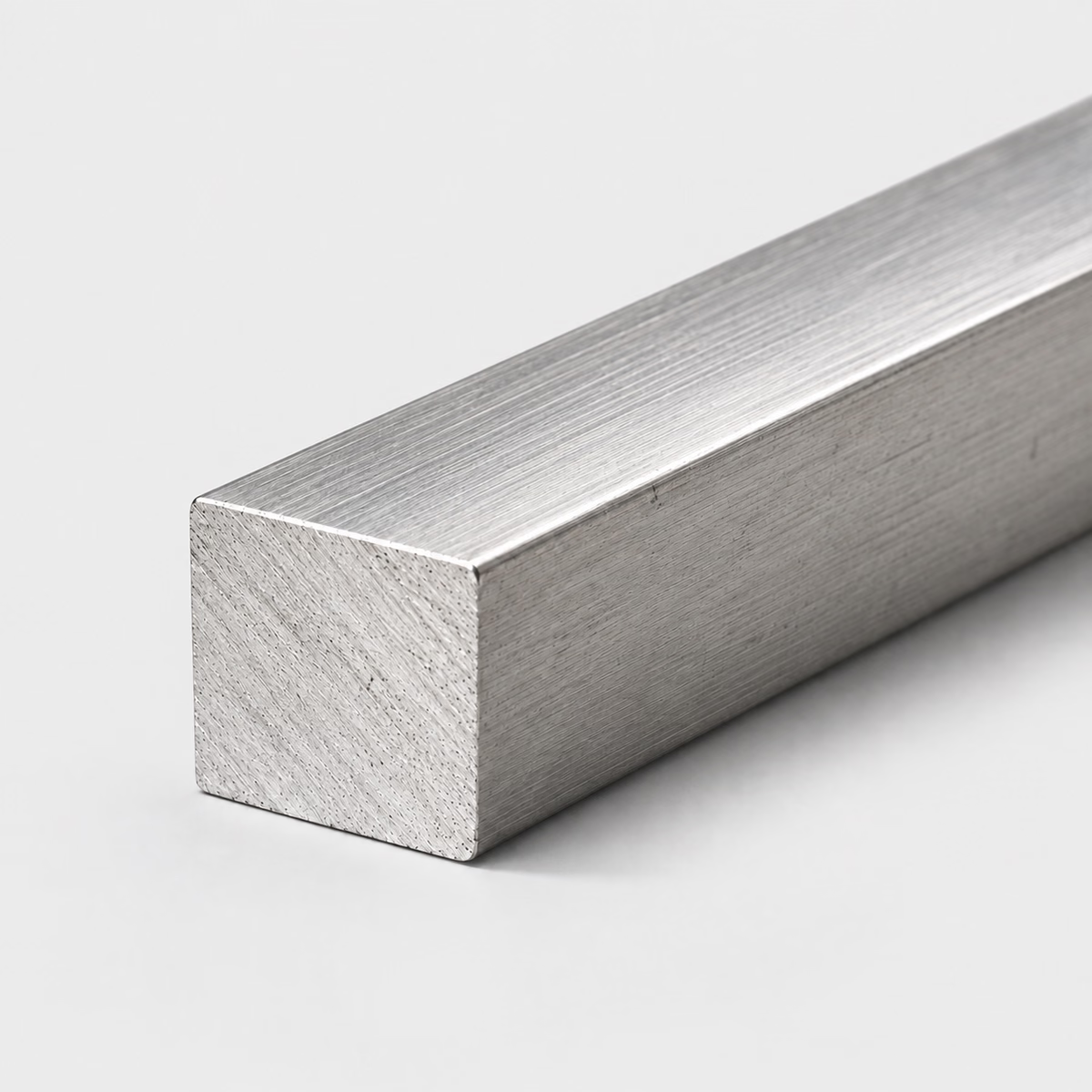
STAINLESS STEEL / SQUARE BARIllustrative material image
LIVE DIMENSION VIEWSQUARE BAR
Stainless Steel Square Bar
See your specification take shape.
Dimension labels are on. Enter dimensions to see their labels.
MADE FOR YOUR CUT LIST
The right metal. Your exact dimensions.
From a single part to a mixed-material project. Configure each cut, then bring it all together in one reviewed quote.
Custom cut sizesMultiple parts, one requestReviewed specifications
CUT-TO-SIZE METAL
304 & 316 Stainless Steel Square Bar
Specify solid stainless square bar by side size and length. Choose a 304 or 316 reference and add stock condition, machining allowance and finish requirements.
Attach a PDF, DXF or STEP file. You can request a review without configuring individual pieces.
How your quote works +
Add one or more cuts, share your requirements and tell us where to deliver. We review material, cutting and freight before sending a quote.
Dimensions & material weight +
Dimensions describe your requested section and cut length. Standard sections and feasible cuts are confirmed during review. Include any tolerance in project details. Weight is theoretical, uses ideal section geometry and excludes corner radii, packaging and cutting loss. The preview is a schematic, not a manufacturing drawing.
PROJECT CONTENTS
Your cut list
Cut lines are saved in this browser. Only added pieces are included in your request.
What to include in your request
List critical face tolerances separately. The square-section name does not guarantee four finished locating surfaces.
Material
Stainless steel
Profile
Square Bar
Grade references
304 / 316 — confirm grade and condition in the quote
Dimensions
Side size, cut length
Units
Inches or millimeters; decimals or fractions
Supply & cutting
Subject to review; no live-stock or tolerance guarantee
Theoretical geometry only. Actual dimensions, tolerances and cutting require supplier review.
01
Use four faces as a design feature
Square bar is a useful starting geometry for small mounting blocks, square-ended spacers and parts that retain flat outside faces. The equal nominal sides provide a simple envelope, but the component's function may depend on only two faces or on a feature machined across several sides. For example, a block seated in a bracket and a decorative exposed block need different surface descriptions. Identify that role before applying the same tolerance or finish requirement to every face.
02
Plan the relationships between machined faces
A block with holes on adjacent sides needs a consistent reference system so the features relate to each other after the part is repositioned. Overall side size does not describe perpendicularity, parallelism or the location of internal features. A drawing with a designated base and reference side makes those relationships easier to read. Cosmetic requirements belong alongside that dimensional information, especially if some stock faces remain visible while other faces are machined and later finished by a different process.
03
Compare blocks with other stock envelopes
Square bar is most directly compared with flat bar when the finished component is rectangular rather than equal-sided. Plate may be useful for a wider footprint, and round bar may suit a part whose main features are cylindrical. The practical tradeoff is the location of excess stock and the faces available for workholding. Compare proposed blanks against the same final drawing; simply choosing the smallest surrounding shape does not establish that the complete machining sequence will work.
Compare stainless block starting forms
Compare stainless block starting forms
Catalog choice
Useful starting point
Process question
Stainless square bar
Equal-sided solid blocks
Which faces remain as supplied?
Stainless flat bar
Unequal rectangular blocks
Where is machining allowance needed?
Stainless round bar
Primarily cylindrical components
Which exterior flats must be created?
PUT THE DIMENSIONS INTO PRACTICE
Example: a four-piece square bar request
Use this illustrative cut line to see how the fields work. It is a dimensional example, not a stock listing or a recommended section for a particular load.
Side size1 in25.4 mm
Cut length12 in304.8 mm
The side size is 1 in, so the ideal solid cross-section is 1 square inch. A 12 in length contains 12 cubic inches of material. The two section dimensions are equal; the third number is length, not a second side size.
How the theoretical weight is calculated
Cross-sectional area × cut length × reference density = estimated material weight.
Material in this example
Stainless steel
Reference for this example
304 grade reference
Density used
7,900 kg/m³
One piece, approximately
3.42 lb / 1.55 kg
Four pieces, approximately
13.70 lb / 6.21 kg
Calculated from ideal geometry and a reference density. Actual section, alloy, tolerances, cutting loss and packaging can change the result. This is not a shipping weight or a load rating.
On your own cut list, add a part reference and quantity to each distinct size. Put extra operations such as holes, miters, threads or finish work on the drawing, then keep that drawing reference with the relevant line.
Is stainless square bar lighter than square tube of the same outside size?
No: for the same material and length, the solid bar contains more material than a hollow tube. Use the correct section when comparing theoretical weights.
Can I specify polished stainless square bar?
You can request a finish and identify exposed faces. The quote must confirm the actual surface and any additional finishing; the grade selection does not include polishing.
Will a nominal square bar fit a machined square pocket?
Not without checking tolerances, corner geometry and clearance. Provide the pocket interface or finished-part drawing when fit matters.
Does equal width and height mean the faces are finished square?
No. Equal nominal side dimensions do not define the complete angular relationship or surface form of a finished block. If those relationships control the assembly, specify them on the part drawing. Keep the raw stock size separate from the final geometric requirements.
How do I show holes that enter three faces of a block?
Use enough views or a sectioned model to show each axis, depth and any intersection. Reference them to the same part coordinate system. Three separate sketches without shared references can describe individual holes while leaving their relationship inside the block unclear.
Can a visible block have different finishes on different faces?
Yes. Label the faces and describe each requirement, including the transitions at shared edges. Identify which faces are machined before finishing. A general finish note for the entire block may impose unnecessary work on concealed faces while leaving the important visual relationships unspecified.
What does a common blank mean for several square-bar parts?
It means different finished components intentionally start from the same raw size and material. Keep their individual drawings and quantities distinct even if the stock is grouped. The common blank simplifies purchasing information, but it does not make the later machining operations identical.
How should I request blocks that sit against a shoulder?
Show the mating shoulder and identify the faces that establish position. Include any required corner clearance and the finished relationship between those faces. A side-size value cannot explain whether the block must contact two faces, clear an inside corner or sit on a defined pad.
How does a pocketed block differ from a plain square spacer?
A pocket introduces an internal floor, walls and corners within the stock envelope. A plain spacer may be defined mainly by external contact faces. The pocketed part therefore needs its internal relationships and machining allowance considered alongside the raw side size and cut length.
What dimensions do I need to request 304 & 316 stainless steel square bar?
Provide side size, cut length, plus quantity for each size. Use inches or millimeters consistently. Add the required grade, condition, finish and any critical tolerances; attach a drawing for details the standard fields cannot describe.
Turn your specification into a clear request.
Include the material, dimensions, quantity and critical requirements. Availability, supplied condition, cutting and delivery are confirmed in a reviewed quote.