Add it to your cut list, or continue with the pieces and files already included.
CUT TO YOUR DIMENSIONS
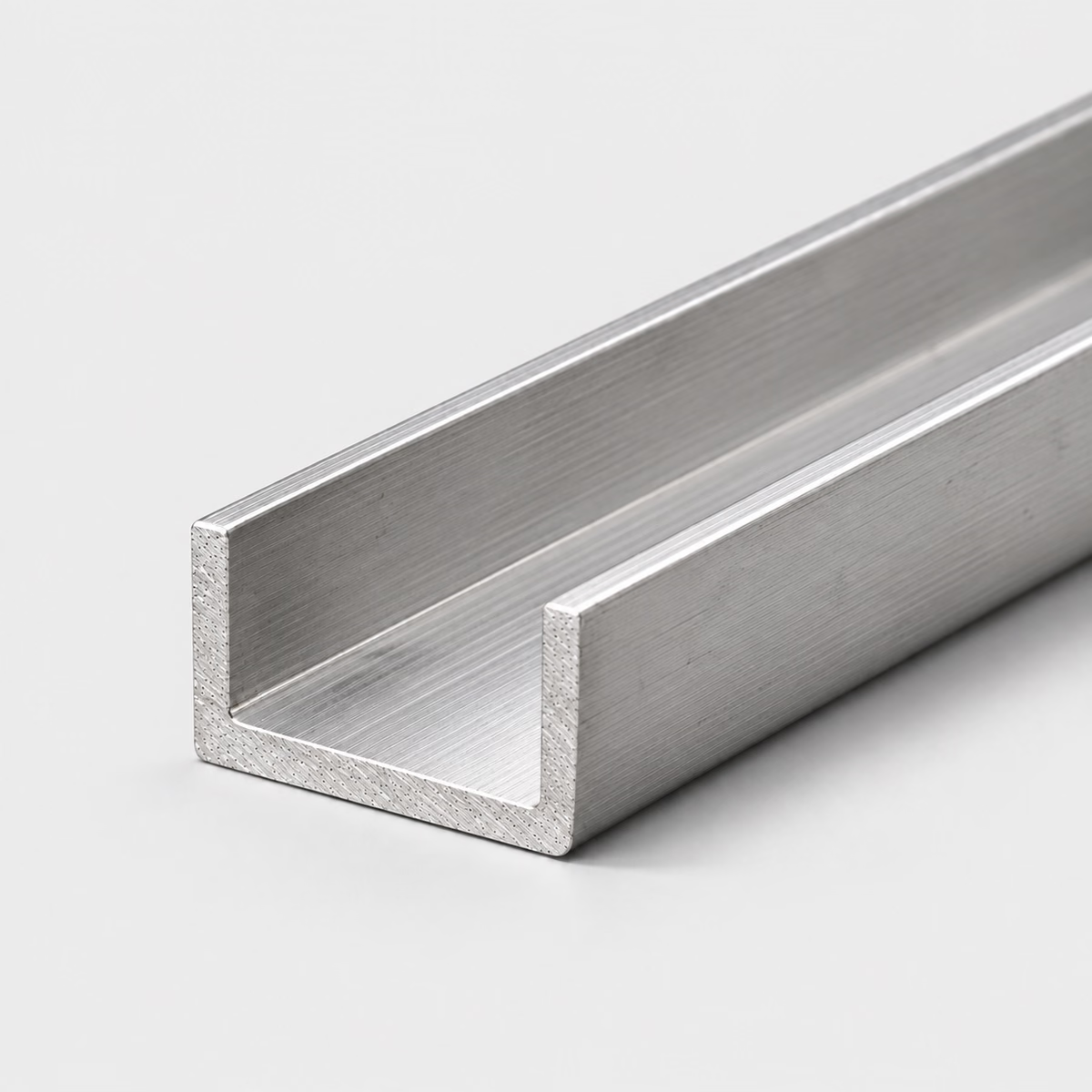
STAINLESS STEEL / CHANNELIllustrative material image
LIVE DIMENSION VIEWCHANNEL
Stainless Steel Channel
See your specification take shape.
Dimension labels are on. Enter dimensions to see their labels.
MADE FOR YOUR CUT LIST
The right metal. Your exact dimensions.
From a single part to a mixed-material project. Configure each cut, then bring it all together in one reviewed quote.
Custom cut sizesMultiple parts, one requestReviewed specifications
CUT-TO-SIZE METAL
304 & 316 Stainless Steel Channel
Request stainless channel with a 304 or 316 reference and a clear section definition. Specify height, flange width, thickness and length, supported by a drawing.
Attach a PDF, DXF or STEP file. You can request a review without configuring individual pieces.
How your quote works +
Add one or more cuts, share your requirements and tell us where to deliver. We review material, cutting and freight before sending a quote.
Dimensions & material weight +
Dimensions describe your requested section and cut length. Standard sections and feasible cuts are confirmed during review. Include any tolerance in project details. Weight is theoretical, uses ideal section geometry and excludes corner radii, packaging and cutting loss. The preview is a schematic, not a manufacturing drawing.
PROJECT CONTENTS
Your cut list
Cut lines are saved in this browser. Only added pieces are included in your request.
What to include in your request
Specify the inside opening and root radii when the channel wraps around, supports or guides another component.
Material
Stainless steel
Profile
Channel
Grade references
304 / 316 — confirm grade and condition in the quote
Subject to review; no live-stock or tolerance guarantee
Ideal uniform-thickness section. Weight excludes root radii, tapered flanges and tolerances. Requested dimensions do not imply arbitrary sections can be manufactured.
01
Choose the opening around its function
A stainless channel may surround a panel edge, provide an accessible mounting member or guide a separate component. Each role emphasizes different parts of the section. An edge surround needs coverage and clearance, a mounting member needs tool access, and a guide needs defined contact and alignment. Begin with a section through the installed assembly. It shows why the opening exists and which surfaces matter, making the material request more useful than an outside envelope that leaves the interior relationship unexplained.
02
Keep the web, flanges and ends distinct
The web is the connecting back of the channel, and the flanges form its sides. Using those names consistently makes hole and finish instructions easier to follow. A polished exterior does not define the inside opening, and a hole in a flange is different from a hole in the web. For a channel that remains open in service, include access for inspection and cleaning in the assembly discussion. Surface condition and confined joints deserve attention alongside the stainless grade, especially where the design retains moisture or deposits.
03
Compare open access with a closed member
Channel leaves one side accessible, while rectangular tube surrounds an opening on all four sides. Angle removes one of the channel's flanges and may suit a simpler edge connection. These changes affect hardware access, visual coverage and the path by which another component enters the assembly. Compare them using the actual insert, panel or bracket drawing. A nominally similar outside dimension does not preserve the inside clearance or mounting arrangement when the number of enclosing faces changes.
Compare stainless sections around an opening
Compare stainless sections around an opening
Catalog choice
Useful starting point
Main relationship
Stainless channel
An open-sided surround or guide
Opening, web and flange interfaces
Stainless rectangular tube
A closed surrounding member
End access and internal envelope
Stainless angle
A simpler two-leg connection
Coverage and mounting planes
PUT THE DIMENSIONS INTO PRACTICE
Example: a four-piece channel request
Use this illustrative cut line to see how the fields work. It is a dimensional example, not a stock listing or a recommended section for a particular load.
Flange width1 in25.4 mm
Outside height2 in50.8 mm
Uniform thickness0.125 in3.175 mm
Cut length24 in609.6 mm
The model uses a 2 in outside height, 1 in flange width and 1/8 in uniform thickness. Its ideal area is t × (2b + h − 2t), or 0.46875 square inches. A channel with tapered flanges or a different web thickness requires its actual section data.
How the theoretical weight is calculated
Cross-sectional area × cut length × reference density = estimated material weight.
Material in this example
Stainless steel
Reference for this example
304 grade reference
Density used
7,900 kg/m³
One piece, approximately
3.21 lb / 1.46 kg
Four pieces, approximately
12.84 lb / 5.83 kg
Calculated from ideal geometry and a reference density. Actual section, alloy, tolerances, cutting loss and packaging can change the result. This is not a shipping weight or a load rating.
On your own cut list, add a part reference and quantity to each distinct size. Put extra operations such as holes, miters, threads or finish work on the drawing, then keep that drawing reference with the relevant line.
Is stainless channel the same as folded stainless sheet?
Not necessarily. Production method can change geometry, radii and stock condition. State whether a fabricated alternative is acceptable for the design.
How do I specify different web and flange thicknesses?
Attach a section drawing or full designation showing both. The configurator uses one uniform-thickness value and cannot fully describe that nonuniform section.
Will 316 channel fit a component based on outside dimensions alone?
No. Fit also depends on the clear opening, radii, tolerances and any finish. Provide the mating geometry and required clearance.
Which part of a channel is the web?
The web is the connecting back between the two flanges; the flanges form the sides of the opening. Label these parts on a section drawing when locating holes or finish requirements. That terminology helps prevent a back-face operation from being interpreted as a side-face operation.
What is the difference between a channel surround and a channel guide?
A surround may primarily cover or retain an edge, while a guide controls how another component moves or locates. The guide needs defined contact surfaces, clearance and alignment. A visually suitable surround should not be treated as a functional moving guide based only on its nominal opening.
How do I specify a panel captured between channel flanges?
Show the panel thickness, edge shape and required clearance inside the opening. Identify whether it enters from an end or through the open side and whether it must remain removable. Those details distinguish a simple cover from a fitted panel-retention arrangement.
Should inside finish be specified when only the outside is visible?
Only require the finish that the interior's function needs, but describe that function explicitly. The inside may contact an insert or need an agreed cleaning condition even when hidden. Keeping internal and external requirements separate avoids confusing cosmetic appearance with the channel's working surfaces.
How can I describe access for fastening through the web?
Show the fastener, tool approach and available space between the flanges in an assembly section. A hole through the web does not ensure that a tool can reach it after surrounding components are installed. Include the assembly sequence if access changes as parts are added.
What should I compare before replacing channel with rectangular tube?
Compare how the component is inserted, how internal fasteners are reached and which surfaces must remain accessible. Closing the fourth side changes those relationships even if some outside dimensions match. Review the end connections and maintenance access along with the revised section envelope.
What dimensions do I need to request 304 & 316 stainless steel channel?
Provide flange width, outside height, uniform thickness, cut length, plus quantity for each size. Use inches or millimeters consistently. Add the required grade, condition, finish and any critical tolerances; attach a drawing for details the standard fields cannot describe.
Turn your specification into a clear request.
Include the material, dimensions, quantity and critical requirements. Availability, supplied condition, cutting and delivery are confirmed in a reviewed quote.