Add it to your cut list, or continue with the pieces and files already included.
CUT TO YOUR DIMENSIONS
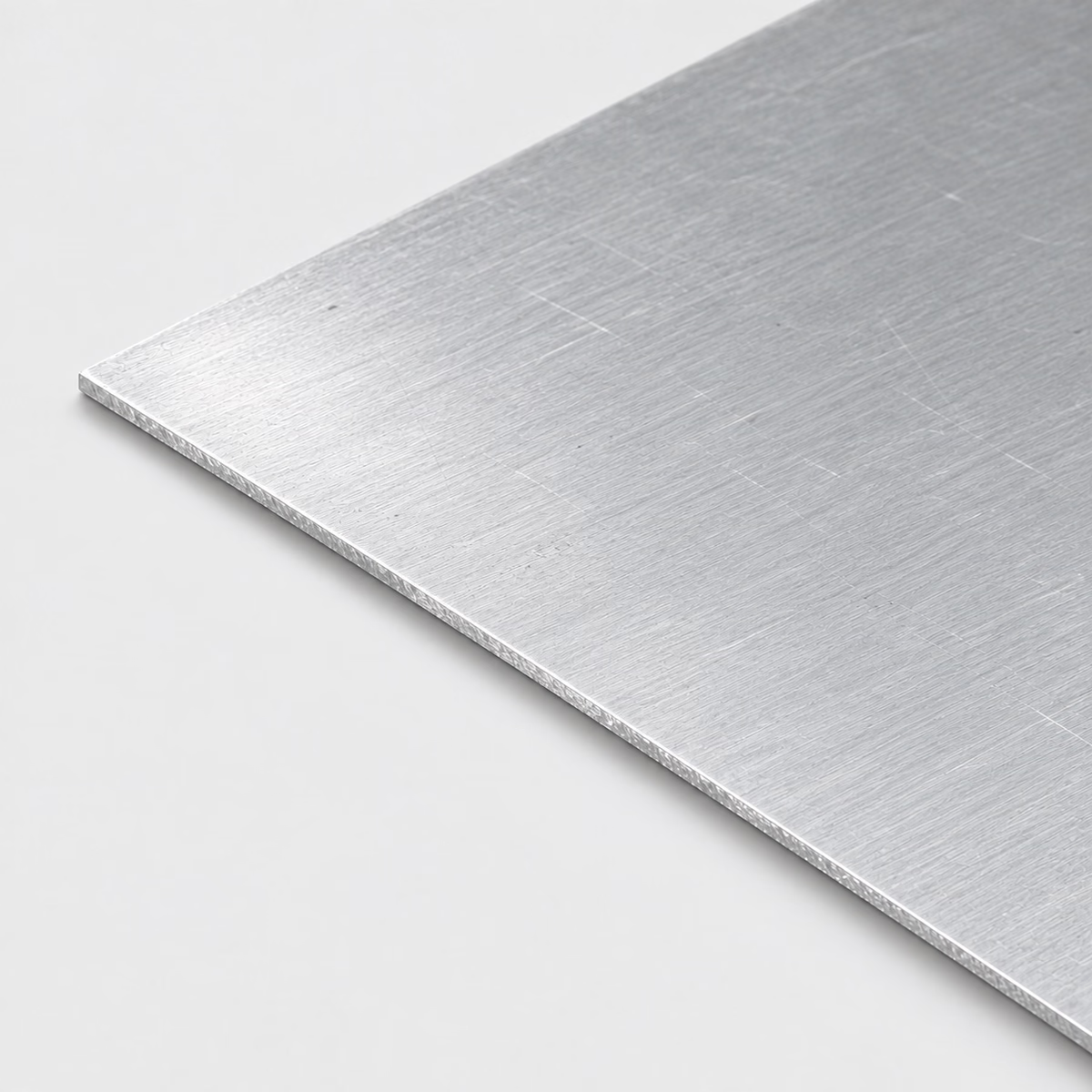
ALUMINUM / SHEETIllustrative material image
LIVE DIMENSION VIEWSHEET
5052 Aluminum Sheet
See your specification take shape.
Dimension labels are on. Enter dimensions to see their labels.
MADE FOR YOUR CUT LIST
The right metal. Your exact dimensions.
From a single part to a mixed-material project. Configure each cut, then bring it all together in one reviewed quote.
Custom cut sizesMultiple parts, one requestReviewed specifications
CUT-TO-SIZE METAL
5052 Aluminum Sheet
Request 5052 aluminum sheet for panels, covers and formed blanks. Specify actual thickness, flat size and temper, with bend and finish requirements on your drawing.
Attach a PDF, DXF or STEP file. You can request a review without configuring individual pieces.
How your quote works +
Add one or more cuts, share your requirements and tell us where to deliver. We review material, cutting and freight before sending a quote.
Dimensions & material weight +
Dimensions describe your requested section and cut length. Standard sections and feasible cuts are confirmed during review. Include any tolerance in project details. Weight is theoretical, uses ideal section geometry and excludes corner radii, packaging and cutting loss. The preview is a schematic, not a manufacturing drawing.
PROJECT CONTENTS
Your cut list
Cut lines are saved in this browser. Only added pieces are included in your request.
What to include in your request
Mark the visible face and rolling direction if the bend layout or appearance depends on them. Use blank dimensions unless a finished-part drawing says otherwise.
Material
Aluminum
Profile
Sheet
Grade references
5052 — confirm grade and condition in the quote
Dimensions
Thickness, width, length
Units
Inches or millimeters; decimals or fractions
Supply & cutting
Subject to review; no live-stock or tolerance guarantee
Theoretical geometry only. Actual dimensions, tolerances and cutting require supplier review.
01
A flat blank is different from the face of a finished cover
A folded cover starts as a flat blank whose material becomes both the main panel and its returns. Its finished front-face dimensions therefore do not describe the complete starting rectangle. Cutouts and corner reliefs can also change the outline before forming. This distinction matters for an equipment enclosure: a blank sized only to the visible face leaves the returns undefined. The completed cover is the design reference, while the forming plan establishes the developed blank and the condition required for its bends.
02
Panel appearance continues around the perimeter
The broad face controls much of a panel's appearance, while its cut edges affect handling and the junction with surrounding parts. A removable cover may retain exposed edges, whereas the edges of an enclosed liner may be concealed by adjacent components. Those parts need different acceptance descriptions even when the sheet dimensions match. The visible-face orientation also matters in a group of panels. Protective film is a separate handling request; it does not define the underlying finish or the treatment of the completed edge.
03
Choose a panel strategy before increasing thickness
Compare a flat sheet panel with an assembly that uses separate angle or channel around its perimeter. The latter introduces joints and extra parts, but it may suit a replaceable cover or a panel that needs an accessible mounting edge. A machined base with pockets belongs in the plate discussion instead. Keep the alternatives tied to the actual drawing: appearance, opening access, fastener locations and fabrication sequence are more useful selection criteria than choosing whichever product photograph looks closest to the finished part.
Compare starting forms for a cover or panel
Compare starting forms for a cover or panel
Catalog choice
Useful starting point
Check before choosing
5052 aluminum sheet
Flat blanks for a formed cover
Flat pattern, condition and visible face
6061 aluminum plate
A machined base or pocketed panel
Machining allowance and locating surfaces
Aluminum angle
A separate perimeter or mounting edge
Joint layout and panel clearance
PUT THE DIMENSIONS INTO PRACTICE
Example: a four-piece sheet request
Use this illustrative cut line to see how the fields work. It is a dimensional example, not a stock listing or a recommended section for a particular load.
Thickness0.0625 in1.5875 mm
Width12 in304.8 mm
Length24 in609.6 mm
Here the thickness is 1/16 in (1.5875 mm), the width is 12 in and the length is 24 in. Keep the blank size separate from a folded part’s finished face dimensions. For a nesting layout, the number of blanks that fit also depends on cutting gaps, edge margins and grain direction.
How the theoretical weight is calculated
Cross-sectional area × cut length × reference density = estimated material weight.
Material in this example
Aluminum
Reference for this example
5052 grade reference
Density used
2,680 kg/m³
One piece, approximately
1.74 lb / 0.79 kg
Four pieces, approximately
6.97 lb / 3.16 kg
Calculated from ideal geometry and a reference density. Actual section, alloy, tolerances, cutting loss and packaging can change the result. This is not a shipping weight or a load rating.
On your own cut list, add a part reference and quantity to each distinct size. Put extra operations such as holes, miters, threads or finish work on the drawing, then keep that drawing reference with the relevant line.
Should I choose 5052 sheet or 6061 plate for a folded cover?
For a formed sheet part, 5052 is a useful reference to discuss. The thickness, temper and bend geometry still need checking. A 6061 plate blank is a different starting form; do not substitute it based only on matching thickness.
Does H32 mean the same thing as the 5052 alloy?
No. 5052 is the alloy and H32 is a temper designation. Record both when specified. If the drawing does not identify a temper, request advice rather than assuming every 5052 sheet bends alike.
Can I order this sheet by gauge?
Provide the actual thickness in inches or millimeters as well as any gauge reference. Also give the flat width, length and quantity so the request does not depend on an ambiguous gauge label.
Why is a finished cover size different from its flat blank size?
The blank contains the material that becomes the cover face and its folded returns. Finished outside dimensions therefore do not describe the whole starting outline. Corner reliefs and cutouts add further differences, which is why a developed flat pattern belongs to the forming plan.
How do I describe a panel with one presentation face?
Mark the presentation face on the drawing and explain which marks are unacceptable there. Identify whether the reverse face has different expectations. If several panels sit together, show their installed orientation so any directional finish can be reviewed as an assembly.
What is the difference between an overlay panel and an inset panel?
An overlay panel extends across the surrounding opening or frame, while an inset panel sits within it. Their clearance and edge relationships are different even when they cover the same opening. That distinction helps establish whether the visible perimeter hides a joint or must fit inside it.
How should I specify edges that people will handle?
Identify the exposed edges and describe the required edge treatment on the drawing. A general request for a clean cut does not define a radius, chamfer or fully finished hand-contact edge. Keep hidden mounting edges separate if their treatment can be different.
Does a protective film define the quality of the sheet underneath?
No. Film describes a protection measure, while the underlying surface still needs an appearance requirement. A group of visible panels may need a consistent finish direction or agreed sample independently of film. The protection and the finished visual acceptance are separate parts of the specification.
Should protective film be specified before the blank is cut?
Describe which face needs protection and which later operations are planned, including forming and finishing. Ask for the proposed protection to be identified with the material scope. Do not assume a photographed sheet surface includes film or that an unspecified film suits every later process.
What dimensions do I need to request 5052 aluminum sheet?
Provide thickness, width, length, plus quantity for each size. Use inches or millimeters consistently. Add the required grade, condition, finish and any critical tolerances; attach a drawing for details the standard fields cannot describe.
Turn your specification into a clear request.
Include the material, dimensions, quantity and critical requirements. Availability, supplied condition, cutting and delivery are confirmed in a reviewed quote.