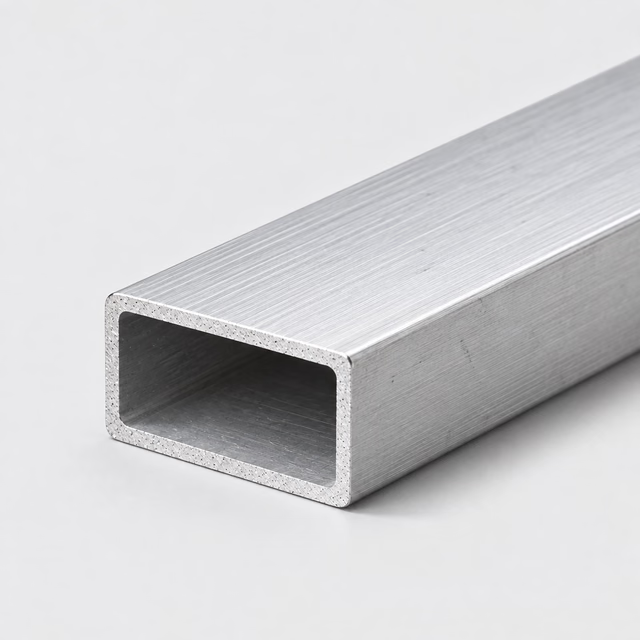
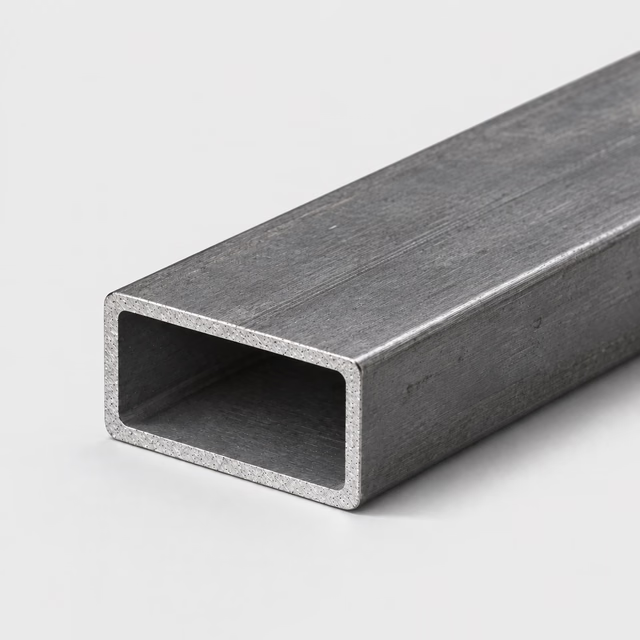
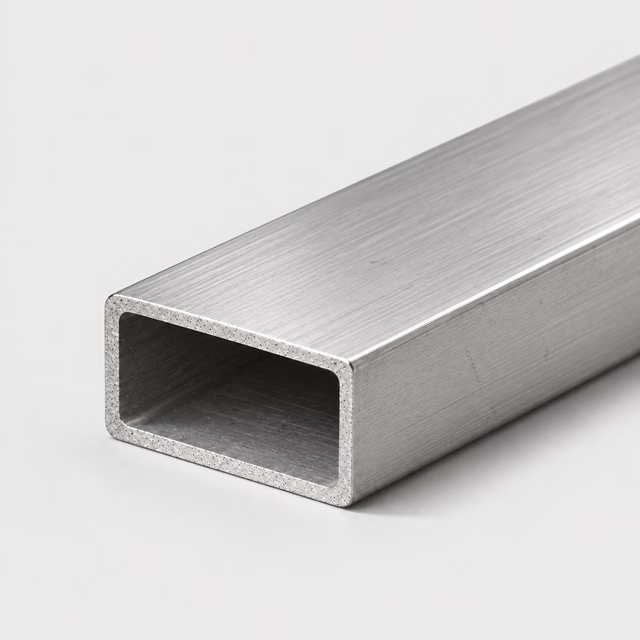
This range describes material and profile combinations available to request. It does not represent live stock, confirmed grades, cutting capacity or delivery dates.
A rectangular section has two unequal outside dimensions. Its installed orientation matters to the assembly, especially when the part is loaded, drilled or joined. Identify which face is up and provide a drawing for end cuts, seams or face-specific details.
State outside width, outside height, wall and length.
Label the installed orientation and any visible face.
Use a drawing for miters, hole locations and joint geometry.
01
Name both sides and show the orientation
Rectangular tube needs more than a pair of unlabeled numbers. Identify the two outside dimensions, wall thickness and supplied length, then show the section's orientation in the assembly. This is especially useful where the same profile appears horizontally and vertically or connects to different brackets. Label the faces used for holes, finishes or mating parts. A small end view beside the cut list can prevent an otherwise correct stock size from being fabricated in the wrong orientation.
02
A shallow profile can suit a constrained envelope
A rectangular section occupies different amounts of space in its two principal directions. That can suit a machine guard, furniture detail or frame member where one direction has limited clearance but the other has more room. It also creates different mounting faces for panels and brackets. The shape can solve an envelope problem without being interchangeable in every orientation. Compare the whole installed arrangement, including connections and any design requirements, rather than selecting from the wider dimension alone.
03
Wall thickness changes the interior, even when the outline stays
Two rectangular tubes can share the same outside dimensions while leaving different interior openings. Wall thickness and corner geometry are therefore relevant when a component enters the tube or contacts an inside surface. Conversely, a panel attached to the outside may care most about the external face and connection details. This distinction helps focus the specification on the working interface. A larger wall is not automatically a better choice if it consumes space that another component needs.
Compare rectangular-tube design choices
Compare rectangular-tube design choices
Choice
Practical effect
Useful check
Broad side against a panel
Changes the available attachment face
Panel interface and fastener layout
Shallow side within a tight envelope
Uses less space in one direction
Clearance to adjacent components
Thicker wall at the same outside size
Reduces the interior opening
Fit of inserts and internal parts
Reoriented member
Moves faces and clearances within the assembly
Full installed arrangement and design requirements
PUT THE DIMENSIONS INTO PRACTICE
Example: a four-piece rectangular tube request
Use this illustrative cut line to see how the fields work. It is a dimensional example, not a stock listing or a recommended section for a particular load.
Outside width2 in50.8 mm
Outside height1 in25.4 mm
Wall thickness0.125 in3.175 mm
Cut length24 in609.6 mm
The outside section is 2 × 1 in with a 1/8 in wall. Subtracting two walls gives an ideal 1.75 × 0.75 in internal rectangle. This ignores rounded corners and any seam; use it to understand the fields, not as a guaranteed clearance envelope.
How the theoretical weight is calculated
Cross-sectional area × cut length × reference density = estimated material weight.
Material in this example
Aluminum
Reference for this example
6061 grade reference
Density used
2,700 kg/m³
One piece, approximately
1.61 lb / 0.73 kg
Four pieces, approximately
6.44 lb / 2.92 kg
Calculated from ideal geometry and a reference density. Actual section, alloy, tolerances, cutting loss and packaging can change the result. This is not a shipping weight or a load rating.
On your own cut list, add a part reference and quantity to each distinct size. Put extra operations such as holes, miters, threads or finish work on the drawing, then keep that drawing reference with the relevant line.
Does rotating rectangular tube change its behavior?
Yes. Orientation changes how the section responds to bending. A load-bearing design must evaluate the installed orientation together with supports, loads and connections.
Are the corners perfectly square inside?
Do not assume sharp internal corners. Real radii and seams can limit clearance for inserts; include fit requirements in the request.
Is rectangular tube the same as flat bar?
No. Rectangular tube is hollow and has a wall dimension. Flat bar is solid. Similar outside dimensions do not make them interchangeable.
How should I label the wide and narrow sides of rectangular tube?
Use explicit dimension labels and an end view, then show the installed orientation on the assembly drawing. Identify the face used for any holes or mating hardware. This avoids relying on informal width and height terms that can reverse when the member is turned.
Why use rectangular tube where a square profile also seems to fit?
The unequal dimensions can provide a broader mounting face in one direction while keeping a shallower envelope in the other. That may suit panels, hardware or available space. The choice still depends on the actual assembly and design requirements, rather than appearance or one matching outside dimension.
Will two rectangular tubes with the same outside size have the same interior?
Not necessarily. Different wall requirements leave different internal openings, and the actual corner geometry also matters to a mating part. A component that fits inside one tube should not be assumed to fit another solely because their outside dimensions have the same nominal values.
Does a thicker wall make an outside mounting face wider?
Keeping the same outside section preserves the external envelope while moving the inside boundary inward. The usable mounting detail still depends on corners, holes and the fastener arrangement. Distinguish the outside face dimensions from the wall and internal-space requirements when evaluating the connection.
What should I check before accepting another rectangular-tube size?
Review both outside dimensions, the wall requirement, mating hardware and the space available in the assembly. Ask the responsible designer or fabricator to assess any design implications. Update the drawings and cut list only after the proposed change has been accepted for the complete application.
Turn your specification into a clear request.
Include the material, dimensions, quantity and critical requirements. Availability, supplied condition, cutting and delivery are confirmed in a reviewed quote.