Square tube for hollow-section projects.
Browse square tube in aluminum, carbon steel and stainless steel. Record the outside side dimension, wall thickness and cut length for each piece.
Selection guide & common questions ↓Choose your square tube material
3 matching products · Open a product to configure your dimensions.
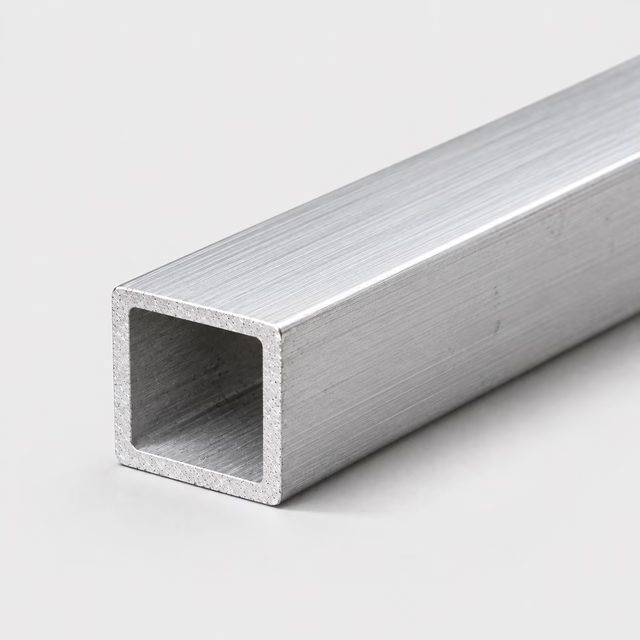 ↗
↗Aluminum Square tube
6061 / 6063
Choose dimensions & quantity →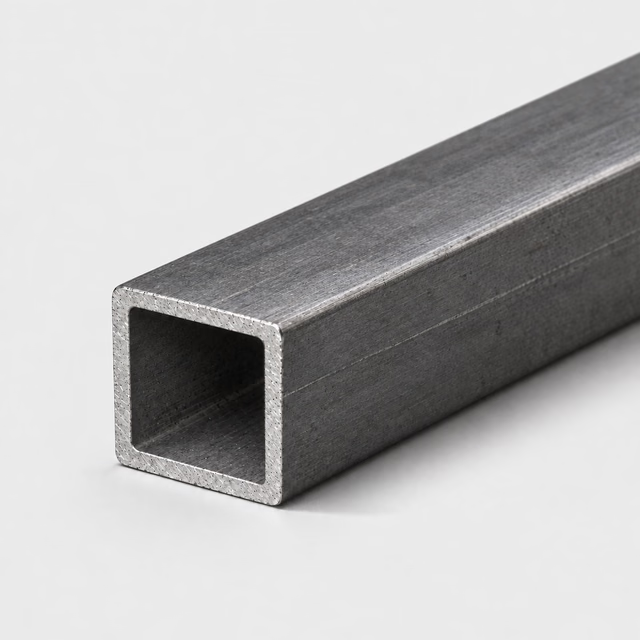 ↗
↗Carbon steel Square tube
Grade to be specified
Choose dimensions & quantity →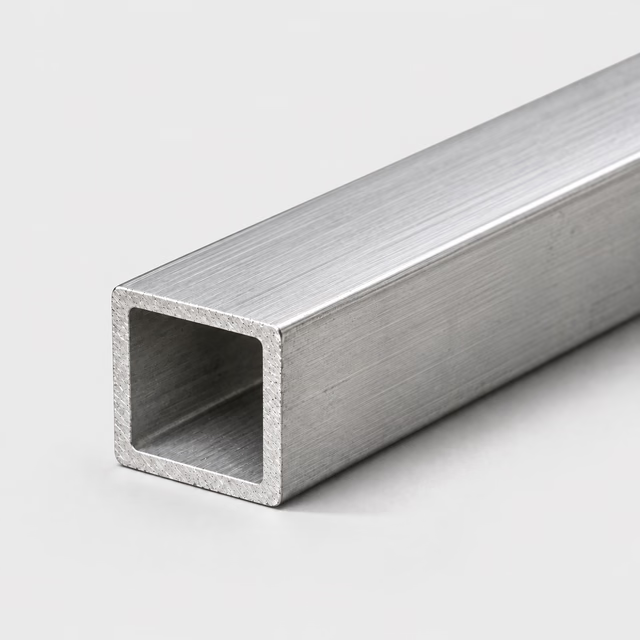 ↗
↗Stainless steel Square tube
304 / 316
Choose dimensions & quantity →This range describes material and profile combinations available to request. It does not represent live stock, confirmed grades, cutting capacity or delivery dates.
A square-tube preview shows simplified geometry. Real sections can have rounded corners, wall variation and a seam. Those features matter when another section slides inside, when a fastener bears near a corner or when a cap must fit closely.
- Specify outside size, wall and cut length.
- Provide required clearance for telescoping parts.
- Identify corner radii and seam restrictions if they affect fit.
The hollow space changes connection options
Square tube places material around an enclosed opening, giving a frame member exterior faces without a solid center. That opening can accommodate inserts or other components, but it also changes access compared with an open channel. A fastener detail that needs a hand or tool behind the wall may be awkward after the frame is closed. Considering access early can be more useful than choosing the section from appearance alone. The connection should suit the profile as well as its dimensions.
Keep exterior appearance consistent across a frame
On a visible frame, the exposed faces and joint locations affect how the finished work is judged. Mark which sides will be seen and describe the intended coating or finishing process. If matching members will be finished together, provide that context and identify any surfaces that need different treatment. Ask the finishing shop to define the receiving condition it requires. A coordinated appearance brief is more useful than assuming every face of an unfinished tube already meets the final visual target.
Mitered frames need an unambiguous length reference
A miter cuts an end at an angle rather than square across the member. Its two sides therefore end at different positions, so a single unlabeled length can be ambiguous. A frame drawing should show which points define each member's length and how the ends face each other. Straight blanks for later mitering are a different request from finished mitered members. Separating those supply stages prevents an overall frame dimension from being interpreted as a ready-to-cut member length.
Compare square-tube connection details
| Detail | What changes | What to resolve |
|---|---|---|
| External bracket | Contact occurs on an outside wall | Face geometry and attachment design |
| Internal insert | Contact occurs inside the hollow section | Clearance, corner geometry and any interior feature |
| Mitered end | Length differs across the angled end | Long-point or other reference and end orientation |
| Enclosed fastener | Access depends on the assembly sequence | Installation and later service access |
Example: a four-piece square tube request
Use this illustrative cut line to see how the fields work. It is a dimensional example, not a stock listing or a recommended section for a particular load.
The outside side is 1 in and the wall is 1/16 in. The ideal inside flat-to-flat dimension is 0.875 in, before accounting for corner geometry and tolerances. That number alone does not prove a smaller square tube will slide inside.
How the theoretical weight is calculated
Cross-sectional area × cut length × reference density = estimated material weight.
- Material in this example
- Aluminum
- Reference for this example
- 6061 grade reference
- Density used
- 2,700 kg/m³
- One piece, approximately
- 0.55 lb / 0.25 kg
- Four pieces, approximately
- 2.19 lb / 1.00 kg
Calculated from ideal geometry and a reference density. Actual section, alloy, tolerances, cutting loss and packaging can change the result. This is not a shipping weight or a load rating.
On your own cut list, add a part reference and quantity to each distinct size. Put extra operations such as holes, miters, threads or finish work on the drawing, then keep that drawing reference with the relevant line.
Calculate the weight of your own dimensions →Questions about square tube
Will one square tube automatically slide inside another?
No. Nominal outside size and wall alone do not establish a sliding fit. Check internal corner radii, seam, tolerances and the required clearance.
How much weight can square tube support?
That requires a design check using material properties, section data, span, load direction, connections and support conditions. The catalog weight estimate is not a load rating.
Does the weight estimate include rounded corners?
No. The configurator uses an ideal uniform-wall section. Use supplier section data or actual measurements when exact weight or section properties are required.
What should I specify when square tube will receive an end cap?
Provide the cap drawing or interface information and explain whether it fits inside, outside or against the tube end. Identify the dimensions that control that connection. A nominal tube description is useful for discovery, but the actual mating requirement should be reviewed separately.
Why can a bolt connection be awkward inside square tube?
The enclosed section limits access to the back of a wall, especially after other members or end caps are attached. The connection design needs to account for how fasteners are installed and serviced. A square-tube outside size alone does not describe that assembly access.
What does long-point length mean on a mitered tube?
It measures to the projecting points created by angled ends, rather than the shorter side or another reference. A mitered member can therefore have several meaningful lengths. Use a dimensioned drawing to establish the intended reference and end orientation instead of relying on an unlabeled cut-length number.
What is useful to include for a welded square-tube project?
Provide the required material callout, section dimensions and the fabricator's blank list, with the assembly drawing as context. Identify the shop responsible for joining and finishing. Let the qualified design and fabrication team establish the connection requirements rather than deriving them from the tube size alone.
Can an internal seam affect a plate inserted into square steel tube?
It can. Steel Tube Institute describes cases where an interior weld feature prevents a splice plate from sitting flat against a wall. An inserted component therefore needs its actual contact geometry reviewed. The outside section size does not establish a clear, featureless internal surface.
Turn your specification into a clear request.
Include the material, dimensions, quantity and critical requirements. Availability, supplied condition, cutting and delivery are confirmed in a reviewed quote.
Technical references
Background guidance; these references do not certify the material offered for a particular request.