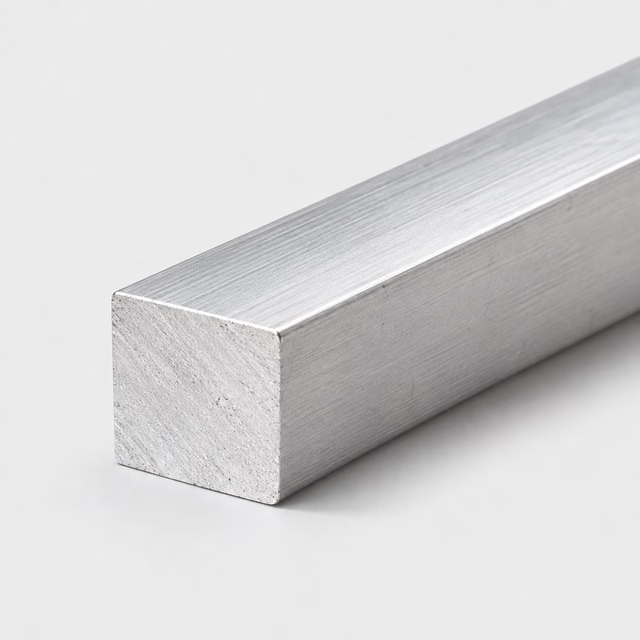
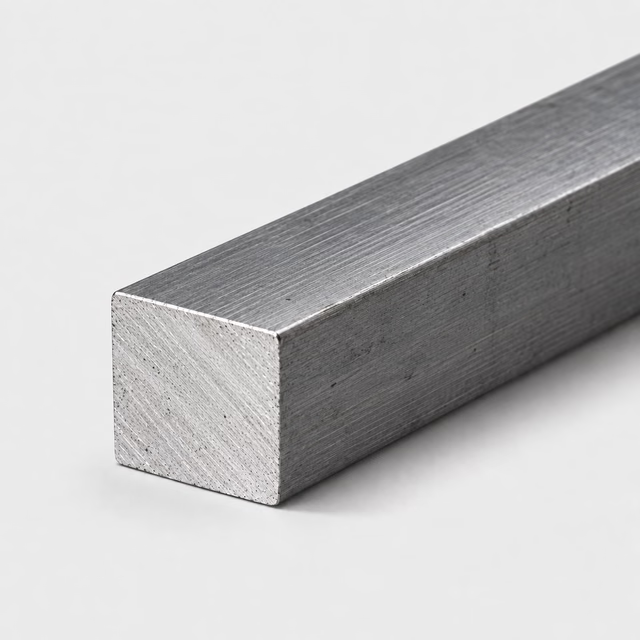
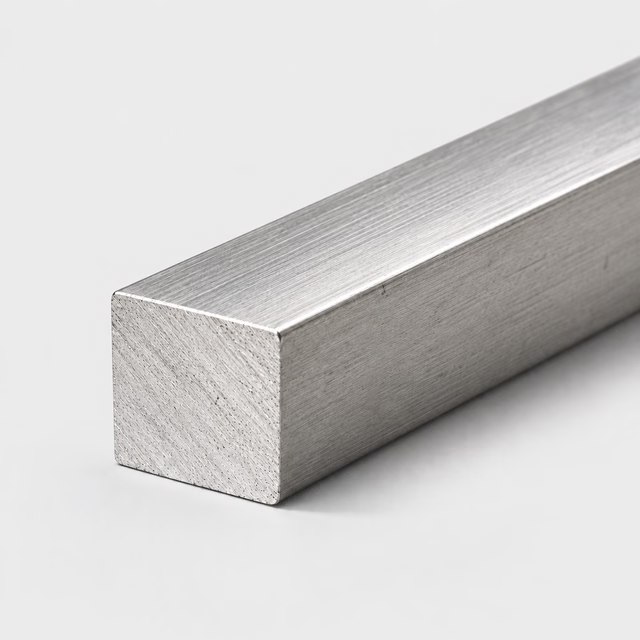
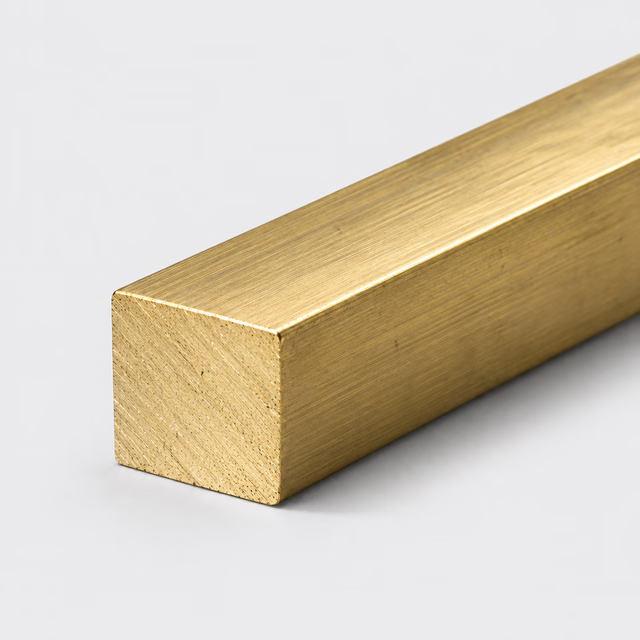
This range describes material and profile combinations available to request. It does not represent live stock, confirmed grades, cutting capacity or delivery dates.
A square bar has a filled cross-section. It can be a starting blank for machined blocks or fabricated details, but nominal side size does not guarantee finished flatness, corner sharpness or squareness. Include those requirements when the faces locate another component.
Give the outside side dimension and cut length.
State machining allowance and critical face requirements.
Choose square tube instead when the section needs to be hollow.
01
Flat faces offer a different starting point from round stock
Square bar supplies four recognizable side faces along a solid section. That can be a convenient starting point for blocks, spacers or details that retain flat surfaces. A round finished part can also be machined from square stock, but its corners represent additional material to remove. Choosing the starting form is therefore a question about the final geometry and machining setup. The closest outline is useful only when it also leaves the stock needed to establish the final surfaces.
02
Clarify what happens at the ends
A square-bar length may be used as a simple blank, a visible post or a component that connects to another part. Each use needs a clear end requirement. Show the intended supplied length and identify any subsequent facing, drilling, threading or end finishing. Where the final assembly dimension is critical, have the fabricator define the blank requirement. A cut list should record what is being purchased, while the finished drawing explains what the workshop will make from it.
03
Across flats and across corners are different dimensions
A square section has one distance between opposite faces and a larger distance between opposite corners. This matters when the part passes through a round opening, rotates near another component or sits diagonally in a bracket. A side dimension alone can therefore be an incomplete description of the required clearance. An end view makes the installed orientation obvious. Evaluate the actual envelope used by the assembly rather than treating the square's side dimension as its maximum width in every direction.
Compare square-bar dimensions and surfaces
Compare square-bar dimensions and surfaces
Feature
What it describes
Why the distinction matters
Across flats
Distance between opposite side faces
Describes the side dimension of the square section
Across corners
The corner-to-corner envelope
Matters to openings and rotated clearances
Stock faces
The incoming surfaces of the blank
May still need machining for a finished interface
Polished appearance
A surface-finish objective
Does not define precise corners or geometric tolerances
PUT THE DIMENSIONS INTO PRACTICE
Example: a four-piece square bar request
Use this illustrative cut line to see how the fields work. It is a dimensional example, not a stock listing or a recommended section for a particular load.
Side size1 in25.4 mm
Cut length12 in304.8 mm
The side size is 1 in, so the ideal solid cross-section is 1 square inch. A 12 in length contains 12 cubic inches of material. The two section dimensions are equal; the third number is length, not a second side size.
How the theoretical weight is calculated
Cross-sectional area × cut length × reference density = estimated material weight.
Material in this example
Aluminum
Reference for this example
6061 grade reference
Density used
2,700 kg/m³
One piece, approximately
1.17 lb / 0.53 kg
Four pieces, approximately
4.68 lb / 2.12 kg
Calculated from ideal geometry and a reference density. Actual section, alloy, tolerances, cutting loss and packaging can change the result. This is not a shipping weight or a load rating.
On your own cut list, add a part reference and quantity to each distinct size. Put extra operations such as holes, miters, threads or finish work on the drawing, then keep that drawing reference with the relevant line.
No. Square bar is solid and has no wall-thickness dimension. Square tube is hollow and requires outside size plus wall thickness.
Are all four sides a precision-machined finish?
No. The stock condition and dimensional tolerances must be confirmed separately. Add a drawing for finished faces or tight fits.
Can I request copper square bar here?
Copper square bar is not a listed family in this range. Use a project sourcing request if you need a material and profile combination outside the catalog.
What does across flats mean for square bar?
Across flats is the distance between two opposite parallel faces. It is different from the corner-to-corner envelope of the section. The distinction matters when a square part fits into an opening or rotates in an assembly, so the clearance should be evaluated in the actual orientation.
What should I specify for square bar that becomes a machined block?
Ask the machining shop to define the required blank size and any receiving conditions. Include the finished block drawing as context, while clearly identifying the dimensions to be supplied. State that machining occurs later unless it is an explicitly separate part of the requested scope.
How do I request square bars with different end details?
Give each distinct part an identifier and drawing, then separate the supplied blank dimensions from the finished end detail. Identify who will perform any drilling, facing or other operation. If only cut blanks are being requested, keep their quantities clear and independent of the assembly notes.
Why can a square-bar blank simplify a flat-sided part?
Its starting section already includes four flat sides, which may suit the part layout and machining setup. That can avoid removing the extra material surrounding a square shape in round stock. The advantage still depends on the finished dimensions, surface requirements and usable stock needed by the machinist.
Does polishing square bar create precise corners?
Polishing is a surface operation and does not by itself define corner geometry, squareness or dimensional tolerance. A visible component may need polishing, while a close-fitting component needs explicit geometric requirements. Keep those objectives separate when deciding what work the blank requires before assembly.
Turn your specification into a clear request.
Include the material, dimensions, quantity and critical requirements. Availability, supplied condition, cutting and delivery are confirmed in a reviewed quote.